How a Simple Booklet Came to Decide Where We Can Travel
Forgotten Pages — The Aiza
Somewhere in a drawer in your house, there’s a small booklet with your photo in it. It doesn’t look like much, a bit of card, a strip of paper, some ink. But that little object decides, more than almost anything else you own, where in the world you’re allowed to go.
We treat passports like they’ve always existed, like they’re just part of how travel works. They haven’t, and they aren’t. The passport, in the form we know it, is barely a hundred years old. Before that, for most of human history, you could cross most borders on Earth without anyone asking who you were at all.
This is the story of how that changed.
When “Papers” Meant Something Different
The idea of carrying a document to prove who you are and why you’re travelling is actually ancient. In the Bible, the Persian king Artaxerxes gives Nehemiah letters asking safe passage through neighboring lands so he can travel to Judah. Roman officials carried something similar, a letter from the emperor asking local authorities to assist the bearer. Along the Silk Road, Chinese travelers carried wooden permits at checkpoints, listing who they were and where they were headed.
But these weren’t passports the way we understand the word. They were closer to a letter of introduction, proof that you were someone worth helping, not a universal ID required of every ordinary traveler.
By medieval Europe, this had evolved into something called a “safe conduct”, a document a king could grant, sometimes even to an enemy, guaranteeing safe passage through his territory for a specific purpose. It was a privilege, not a requirement. Most people crossing most borders needed nothing at all.
A Word Before It Was a Rule
The word “passport” itself shows up in English as early as 1414, mentioned in an Act of the British Parliament. For centuries afterward, it stayed a fairly loose, inconsistent idea, different kingdoms issued their own versions, for their own reasons, mostly to protect merchants or grant favor to elites. In France, King Louis XI began issuing certificates allowing certain people to travel freely through his territory.
For most of history, though, passports were the exception, not the rule. Ordinary people simply walked, sailed, or rode across borders. Nobody checked. Nobody asked. The idea that every single person crossing a border needed a government-issued document just to be allowed through would have seemed strange, even unreasonable, for most of human history.
The World That Made the Passport Necessary
Everything changed after the First World War.
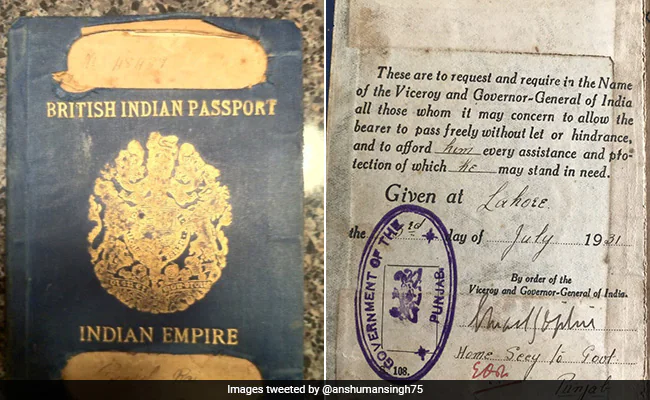
The war had scattered millions of people, soldiers, refugees, displaced families across a Europe whose borders had just been completely redrawn. Governments, for the first time, felt a real need to track exactly who was crossing into their territory, and why. Movement, which had once been mostly unregulated, started to look like something that needed to be controlled.
In 1920, the League of Nations, the international body formed after the war, and the forerunner to today’s United Nations, held a conference specifically to standardize passports across countries. Before this, every nation’s travel documents looked completely different, if they existed at all. The League proposed a common format: booklet-style, a certain size, with specific information laid out in a specific order.
By 1926, more than 40 countries had adopted the League’s recommendations. In a matter of years, the passport transformed from a rare document carried by the occasional diplomat or elite traveler into something every citizen of the modern world was expected to hold. This 1920 conference is really the moment the passport, as we know it today, was born.
It’s worth sitting with why this happened. It wasn’t really about making travel easier for ordinary people. It was about control about states wanting a reliable way to decide who could enter, who could leave, and who counted as “theirs” at all.
The Booklet That Belonged to No Country
Perhaps the most quietly remarkable chapter in this story belongs not to a country, but to people who had none.
After the war, hundreds of thousands of people found themselves without a nation willing to claim them, Russians who had fled the revolution, Armenians who had survived genocide, and others displaced by the collapsing empires of the era. Without citizenship, they had no passport, and without a passport, they legally couldn’t exist anywhere. They couldn’t work, couldn’t cross a border, couldn’t prove who they were to anyone.
A Norwegian explorer named Fridtjof Nansen, famous before the war for his Arctic expeditions had become the League of Nations’ first High Commissioner for Refugees. In 1922, he introduced a solution: a travel document, recognized internationally, that didn’t rely on any nation claiming the holder as a citizen. It became known simply as the Nansen passport a thin, sea-green booklet that gave stateless people, for the first time, a way to exist on paper.
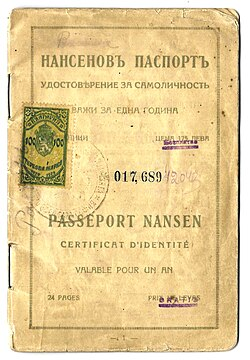
By the time it was phased out in the 1940s, roughly 450,000 people had carried one, recognized by over 50 countries. Its holders included ordinary refugees, but also well-known figures, the painter Marc Chagall, and the writer Vladimir Nabokov, who later described his own Nansen passport as marking its holder out for extra scrutiny at every border he crossed. Nansen himself won the Nobel Peace Prize in 1922, the same year his passport was introduced.
It wasn’t a perfect solution, it mainly covered specific groups, like Russian and Armenian refugees, and left many other displaced people out entirely. But the idea behind it, that a person’s right to travel and be identified shouldn’t only exist because a state claims them, became one of the foundations of modern refugee law, echoed decades later in the 1951 Refugee Convention that still shapes how the world treats refugees today.
What the Booklet Really Decided
Here’s the part of this story that’s easy to miss: a passport was never really about proving who you are. It was always about proving what you’re allowed to do and that permission has never been distributed equally.
A passport issued by one country can open nearly the entire planet, visa-free. A passport issued by another might require weeks of paperwork, interviews, and proof of finances just to visit a neighboring country for a weekend. The booklet looks the same from the outside, same size, same shape, same kind of photo page but what it grants its holder can be worlds apart. That gap didn’t happen by accident. It’s the direct descendant of decisions made a century ago, at conferences most of us have never heard of, by governments deciding who counted as a “safe” traveler and who didn’t.
A Small Object, A Big Question
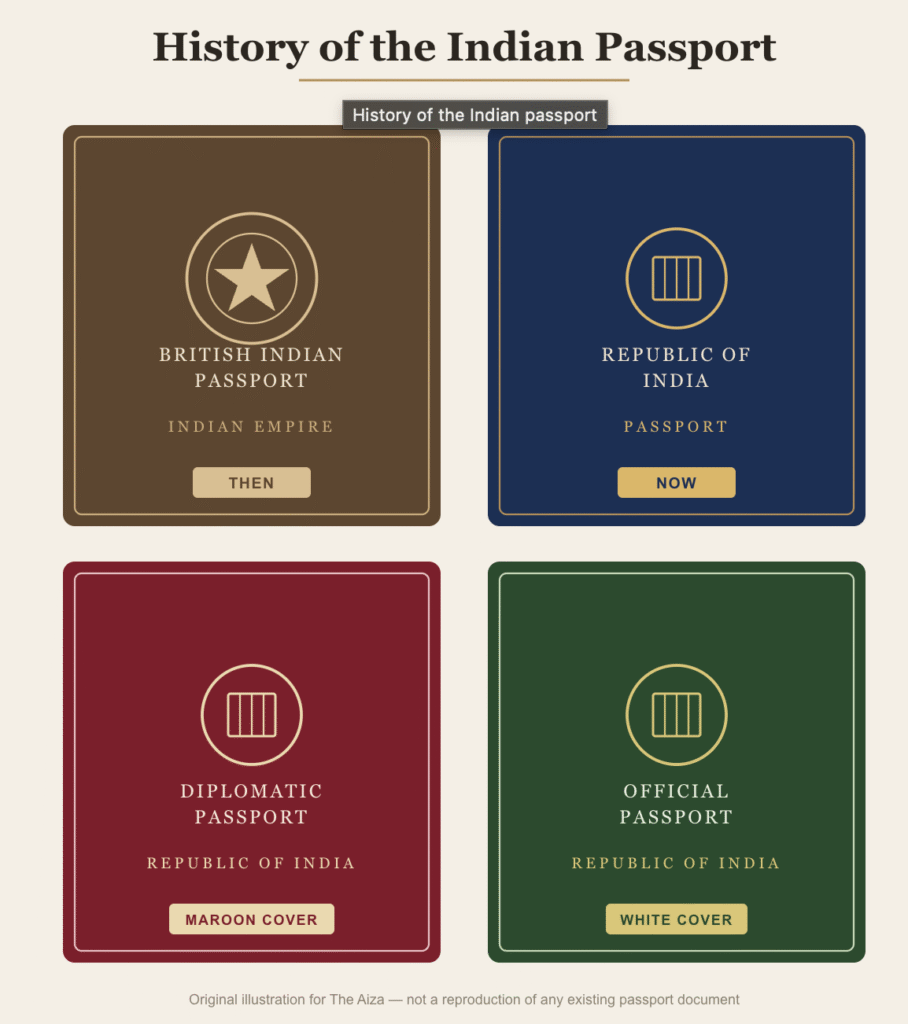
It’s strange to think that something as small as a booklet, smaller than most notebooks, thinner than most wallets, carries this much history inside it. Every stamp, every visa sticker, every crossing it records is really a small trace of a much bigger story: the story of how the world decided that movement itself needed permission.
The next time you hand yours over at a border, it might be worth remembering: for most of human history, no one would have asked.
This is the second piece in Forgotten Pages, a series on The Aiza exploring history that’s slipped out of everyday memory. If you have a piece of forgotten history you think deserves to be remembered, I’d love to hear about it.